

Hire a Supabase monitoring agent (Cursor, Claude, or Codex)
Set up a beginner-friendly Supabase monitoring agent in Cursor. Learn MCP, read-only access, advisors, and a daily Generalist or Security check.
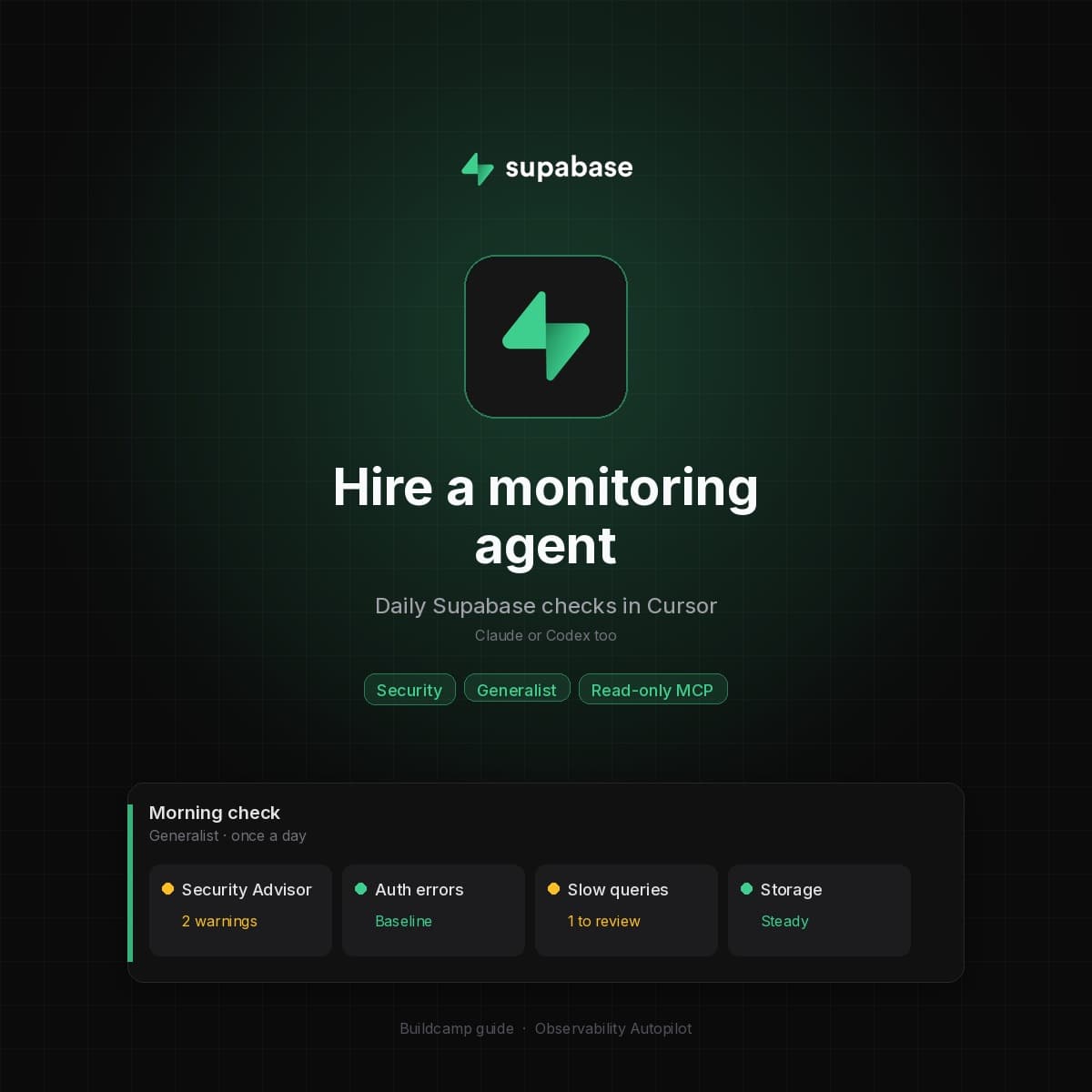
What you will learn
- What a Supabase monitoring agent is, in plain language
- Key terms you will see: MCP, read-only, advisor, and automation
- How to choose either a Generalist or Security daily check
- How to set that check up in Cursor (with a short note on Claude and Codex)
Prerequisites
- A Supabase project you can connect (your course project is fine)
- Cursor installed and signed in
- Optional: the earlier Buildcamp guide Practical guide: Agent Plugins with Supabase
Official docs: Hire an agent.
Core concepts
A monitoring agent is an AI helper with a clear job: look at your Supabase project on a schedule and tell you if something needs attention. It should not change your database for you.
Four words appear often. Learn them once:
- MCP (Model Context Protocol) is how Cursor (and similar tools) talk to Supabase. Think of it as a safe plug-in that lets the agent call approved Supabase tools.
- Read-only means the agent can inspect the project but cannot create, update, or delete data. For monitoring, always keep this on.
- An advisor is a built-in Supabase checker. Security Advisor looks for risks such as missing row level security. Performance Advisor looks for slow or inefficient queries.
- An automation is a scheduled run of the same prompt (for example every weekday morning). Each run starts fresh, so the prompt must include everything the agent needs.
Supabase publishes ready-made roles: Health, Security, Performance, Capacity, and a combined Generalist. For Buildcamp students, start with one daily role:
- Generalist if you want one morning summary across health, security, performance, and usage
- Security if your project uses lots of auth and RLS and you want a focused daily review
You do not need hourly alerts or a full ops setup yet. One clear daily check is enough.
Step-by-step
1. Connect Supabase MCP as read-only
In Cursor:
- Open the Supabase MCP / plugin setup.
- Point it at your project (
project_ref). - Set
read_only=true.
That last step matters. A monitoring agent should report problems, not fix production by accident.
If you already use the Supabase plugin for coding, create or confirm a read-only connection for this monitoring job.
2. Choose Generalist or Security
Pick one for your first week:
- Generalist for a broad daily overview
- Security for RLS and access focused findings
Copy the prepared prompt from Supabase (do not invent a vague "watch my database" prompt):
Other roles (Health, Performance, Capacity) are useful later. Skip them until this first daily check feels useful.
3. Run the prompt once by hand
Before you schedule anything:
- Paste the prepared prompt into a normal Cursor agent chat.
- Confirm it can reach advisors and project info through MCP.
- Read the report. If the project is healthy, a short or quiet reply is fine.
- Confirm it does not try to write or change anything.
Only schedule it after that dry run works.
4. Turn it into a Cursor automation
In Cursor:
- Open Automations (Agents Window, cursor.com/automations, or the
/automateskill). - Name it clearly, for example
Supabase Generalist (read-only)orSupabase Security (read-only). - Choose a scheduled trigger. A simple weekday morning slot in your local time is enough for a student project.
- Paste the same prepared prompt.
- Keep the agent read-only. You do not need a repo attached for a pure monitoring job.
Send findings to wherever you already look each day (email, Slack, or your task tool). The goal is a habit, not another dashboard you forget.
5. Claude and Codex (short note)
The same prepared Supabase prompts work elsewhere:
- Claude Code: create a Routine with the same prompt and a daily schedule
- Codex / ChatGPT: create a scheduled task the same way
This guide uses Cursor as the main path so you learn one flow well. Switch tools later if your course stack prefers Claude or Codex.
Check your understanding
You are ready when you can answer yes to these:
- Can you explain MCP, read-only, advisor, and automation in one sentence each?
- Did you pick either Generalist or Security (not all roles at once)?
- Did you run the prompt once manually before scheduling it?
- Does the agent report findings without changing the project?
Common mistakes
- Using a vague prompt like "monitor everything and fix it". Use a scoped Supabase role prompt instead.
- Leaving MCP on read-write for a monitor. Force read-only.
- Scheduling first and never testing. Always do one manual run.
- Starting three hourly agents on day one. One daily Generalist or Security is enough.
- Worrying when a run is quiet. Silence often means nothing crossed the thresholds.
What's next
- Act on Security Advisor findings (especially missing RLS) from your daily report
- Add a Performance monitor later if you have real traffic or slow queries
- Keep the same Buildcamp habit: ship with Supabase, then keep a standing health check beside it
- Revisit Hire an agent when Supabase updates the prepared prompts
Going further (optional)
- Split Generalist into specialist roles once you know which area needs more attention
- Read the role pages for Health, Performance, and Capacity
- Pair this with Practical guide: Agent Plugins with Supabase if you still need the coding plugin set up
You are not building a full operations centre. You are giving an agent one clear job: scoped checks, read-only tools, and a useful report.